 Shopxare Team
Short answer: to say no to a customer without losing them, name their request and say no in the first two sentences, give the real reason in one line, offer what you can do instead, and end with the next step and a date. Before you send it, check that the request isn't a legal right (a return within 14 days, a faulty item), and ask yourself whether you'd say yes to the next customer who asks for the same thing.
Most guides on this topic are written for call centres or software account managers. A store's "no" is different. It's about money, dates and parcels, it's usually typed into a chat window on a phone, and consumer law decides part of the answer for you. Below you'll find the formula, a table of what you can and can't refuse, 12 templates for online stores and the mistakes that turn a no into a complaint.
The formula: no, because, instead, next
- No, early and plain. Name the request so the customer knows you read it, then say no in the first or second sentence. "I can't refund the difference on order #2231" is kinder than three friendly lines that build up hope first.
- Because: one real reason. Say what the fact is or what the rule protects: "the price was €64 on the day you ordered", "the courier collected it at 11:00". "It's company policy" isn't a reason. It's just a label for one.
- Instead: what you can do. Give one or two concrete options the customer can take or leave. If there's nothing you can offer, say what would change your answer (a photo, a different product, a later date).
- Next: the step and the date. Who does what, and by when. A no that ends with a simple question ("Shall I hold the 42 for you until Friday?") keeps the conversation going.
Why the real reason matters
In a 1978 experiment at Harvard, a researcher asked to cut in line at a photocopier. For a small favour (5 pages), 60% of people let her go first when she gave no reason, and 93–94% did when she gave any reason, even an empty one like "because I have to make copies". For a bigger favour (20 pages), the empty reason did no better than no reason at all (24%). Only a real reason raised it, to 42% (Langer, Blank & Chanowitz, Journal of Personality and Social Psychology, 1978).
A refusal is a big ask, because you're asking the customer to accept a loss. Empty reasons like "policy" or "system limitations" won't carry that weight.
First, check that the answer is yours to give
Some requests aren't favours you can turn down. In the UK and the EU they are rights, and refusing them in chat doesn't make them go away. It just adds a complaint.
| Request | Can you say no? | Rule |
|---|---|---|
| Change-of-mind return within 14 days of delivery | No | UK: Consumer Contracts Regulations 2013; EU: Directive 2011/83/EU, art. 9 |
| Refund of the original standard delivery charge on that return | No | Same rules |
| Repair, replacement or refund for a faulty item | No | UK: Consumer Rights Act 2015; EU: at least 2 years, Directive (EU) 2019/771, art. 10 |
| Return of a personalised or made-to-measure item that isn't faulty | Yes | Directive 2011/83/EU, art. 16 |
| Return of a sealed hygiene item that has been opened | Yes | Same article |
| Change-of-mind return after 14 days | Yes, if you told the customer about the right to cancel | — |
| Price drop after purchase, price match, discounts, express delivery, custom changes | Yes | Your own policy |
This is a summary, not legal advice. If you sell outside the UK and EU, check your local law. The full return process is in how to respond to a refund request.
Should this be a yes?
Before you write the no, ask yourself three questions:
- Would I give the same thing to the next customer who asks? If the answer is yes, this isn't an exception. It's your real policy, so write it down.
- Does granting it cost less than arguing about it? Waiving a €4.90 delivery fee on a €90 order is often cheaper than three more messages and a one-star review.
- Is this the first time for this customer? Leave a note on the contact so a second request is handled with the full picture.
If all three answers are yes, say yes and mention that it's a one-off. If the answer to the first question is no, your answer is no, however nicely the customer asks. In my experience, inconsistent exceptions do more damage than firm rules, because customers compare notes and the ones who got a no feel cheated.
12 templates for online stores
Replace the [brackets]. Each template fits a chat window on a phone. For email, add a greeting and your signature.
1. Return after the 14-day window
I can't accept a return on order [#1234]. It was delivered on [date], so the 14-day window closed on [date]. If something is wrong with the [item], tell me what's happening. Faults are covered separately, and I'll look at it today.
2. Personalised item
I can't take back the [engraved bracelet], because it was made with your [name] and we can't sell it to anyone else. If there's a fault in the engraving, send me a photo and I'll have it remade for free.
3. Price dropped after the customer bought
I can't refund the difference, because the price was [€64] when you ordered and the sale started today. You're still within your 14-day return window, though. You can send it back and order again at [€48], or keep it and I'll give you a [20%] code for your next order. Which do you prefer?
4. Discount request before buying
I can't lower the price of the [sofa], because it's the same price we give everyone. What I can do is [deliver it to your room for free / offer the ex-display one at 15% off]. Shall I reserve it until [Friday]?
5. Expired discount code
The code [WELCOME10] ended on [date], so I can't apply it now. Delivery is free over [€50] and your basket is at [€46]. Want me to suggest something for the last [€4]?
6. A delivery date you can't promise
I can't promise it'll arrive by [Saturday]. Orders placed now ship on [Monday], and the courier takes [1–2 working days]. If you need it for [the 20th], [express delivery for €9] arrives by [Thursday]. Shall I switch it?
7. Change or cancel after dispatch
I can't change the address anymore, because [courier] collected the parcel at [11:00]. You have two options: redirect it in the [courier] app with tracking number [123], or refuse the delivery and we'll refund you once it's back with us.
8. A country you don't ship to
We don't ship to [Norway] at the moment, because [customs fees would add about a third to the price]. If you have an address in [the EU], we can send it there. I've also noted your request, and if we start shipping to [Norway], I'll email you.
9. A product change you don't make
We can't make the [table] in [140 cm]. It only comes in [120 and 160 cm], because the legs are fixed to the frame. The [160 cm] one needs a space of at least [170 cm]. Want me to check your measurements?
10. Price match
We don't match other shops' prices, because every order with us includes [free returns and a 2-year warranty]. If price is what decides it, the [Model B at €39] does the same job without the [timer].
11. Free delivery below the threshold
Free delivery starts at [€50] and your basket is at [€44], so I can't remove the [€4.90] fee. Our [cotton tote at €6] would take you over the threshold, and it costs about the same as delivery.
12. Abusive language
I want to help with your order, and I will, but not while the messages contain insults. If you'd like to continue, write to me about the order and I'll pick it up straight away. Otherwise, I'll close this chat now.
For phrases that work across all of these, see 40 customer service phrases to use and 12 to rewrite. If the "no" is about stock, use the out-of-stock templates.
Example: the Black Friday price drop
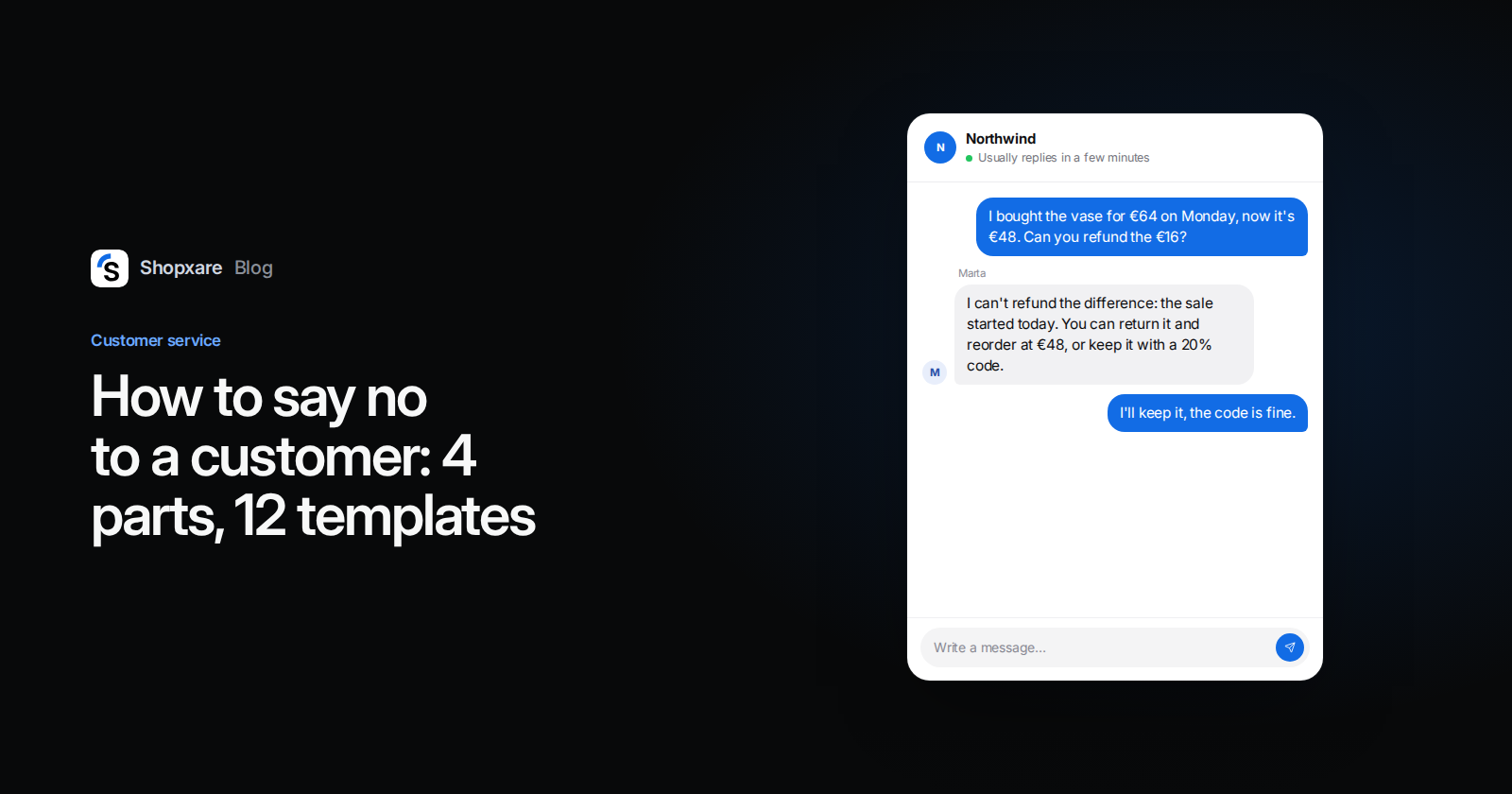
A small ceramics shop sells a blue vase for €64 on Monday. On Friday, it drops to €48 in the sale, and this message comes in through the Messenger:
Customer: I bought the blue vase on Monday for €64 and now it's €48. Can you refund the €16?
Shop: Hi Anna, I can't refund the difference on order #2231, because the sale started today and you ordered at the full price. You're still within your 14 days, though. You can send it back and order again at €48, or keep it and I'll give you a 20% code for your next order. Which would you like?
Customer: I'll keep it, the code is fine.
Shop: Here it is: ANNA20, valid until 31 January.
The customer had a legal way to get the €16 back anyway, through a return and a new order. Saying that openly made the shop look honest, and it gave her a choice she was happy to make. Hiding the option would have been a no she could easily get around, and she would have found out.
Five mistakes that turn a no into a complaint
- Burying the no. If it only appears in the third paragraph, the customer reads the first two as a yes and the third as a reversal.
- "Unfortunately, as per our policy…" These are two phrases with no information. State the rule itself instead.
- Promising what you can't deliver. "I'll see what I can do" without a date is a soft yes that you'll have to take back later.
- Saying no in chat and yes by email. Whatever one teammate grants becomes your policy. Write exceptions on the contact so everyone can see them.
- Letting the AI decide money questions. An AI agent can explain your return policy. Refunds outside the policy, discounts and complaints should go to a person. See when an AI should hand a chat to a person.
Setting it up in Shopxare
- Save the templates. Add the ones you use under Settings → Saved replies, then type
/in the inbox to insert one.{{contact.name | there}}fills in the customer's name (saved replies). - Rewrite a draft before sending. Copilot can rewrite or shorten your reply in the inbox, and nothing goes out until you send it. It helps when you've written a no on a bad day.
- Keep refusals with people. In Are AI → Settings, add refunds outside the window, discounts and complaints to the topics that always go to a person (Are AI).
- Write each rule once. A help center article on returns and the free-delivery threshold gives every no a link to point to, and Are AI answers from the same text (help center).
- Block when you have to. If the abuse continues after template 12, you can block the person (blocking and spam protection).
Shopxare has a free plan. You can see what's included on the pricing page.
FAQ
How do you politely say no to a customer?
Name their request, say no in the first two sentences and give the real reason. Then offer what you can do and the next step. Keep it short, because a long apology reads like an excuse.
What can I say instead of "unfortunately"?
Start with the fact: "The code ended on 10 November" or "The parcel left at 11:00". The fact explains the no without the filler.
Is "it's our policy" a good reason?
Not on its own. Say what the policy is and why it exists, in one sentence, for example: "We can't resell engraved items."
How should I respond when a customer asks for a discount?
If you don't give discounts, say so, and offer something that costs you less: free delivery, a cheaper model or a note when the next sale starts. Don't give discounts to customers who push hard while refusing customers who ask politely.
Can an online store refuse a return?
In the UK and EU, you can't refuse a change-of-mind return within 14 days of delivery, apart from exceptions like personalised items or opened hygiene products. After 14 days you can, if you told the customer about the right to cancel. Faulty items are covered by separate rules.