 Shopxare Team
In short: Good customer service phrases do three things. They say what I will do (not "we"), they name the specific order, product or date instead of "your issue", and they end with the next step and a time. Studies of real retailer conversations back the first two rules. Below are 40 phrases for an online store's chat and email, sorted by the moment you need them, 12 common phrases to rewrite, and a way to make the good ones your team's default.
Most phrase lists online were written for call centres: "thank you for holding", "is there anything else I can help you with today". In a store's chat the customer types on a phone, reads the first line and decides whether you understood. So every phrase here is short, written, and built around orders, sizes, delivery and returns. Replace the names, numbers and carriers with your own.
Two rules with research behind them
1. Say "I" when you are the one acting
Grant Packard, Sarah Moore and Brent McFerran compared support replies that used "I" with the same replies using "we". Customers were more satisfied with the agent and more willing to buy when the agent wrote "I" (Journal of Marketing Research, 2018). In more than 1,000 emails from a large retailer, a 10% increase in agents' use of "I" went with a 0.8% increase in customer purchases, after controlling for other factors (MIT Sloan Management Review, summary by the authors). The explanation they give: "I" sounds like a person who cares and is able to act.
Keep "we" for company rules. "We ship within two working days" is fine. For the action itself, "I've started your refund" beats "your refund has been initiated".
2. Name the specific thing
Packard and Jonah Berger analysed more than 1,000 real conversations between customers and employees and found that customers were more satisfied, more willing to buy, and bought more when employees spoke concretely (Journal of Consumer Research, 2021). In phone calls at a large online clothing retailer, one standard deviation more concrete language went with 8.9% higher satisfaction. Concrete language shows the customer you heard them.
In practice: "I'll look into that" becomes "I'll check where the blue linen dress from order 4821 is with Evri". Product, order number, carrier, date, amount. One or two of those per message is enough.
A smaller one: "the" instead of "your" in bad news
The same research team found that "Sorry your product was defective" scored lower on satisfaction than "Sorry the product was defective" (MIT Sloan Management Review, link above). "Your" ties the problem to the customer. Save it for good things: your refund, your new size, your parcel is on its way.
40 phrases for an online store, sorted by moment
Opening a chat
- "Hi Sarah, I'm Tom from the shop. I can see order 4821 here. What can I help with?"
- "Hi, I'm here. Tell me what you're looking for and I'll find it."
- "Thanks for waiting. I'm reading your message now."
- "Good morning. I've got your email about the delivery and I'm on it."
- "Hi, I'm Tom, a person on the team. The assistant passed me your question about sizes."
Pre-sale questions
- "The M fits a 96–101 cm chest. If you're between sizes, I'd go up: this fabric doesn't stretch."
- "Yes, it's in stock in black and grey. Order before 2 pm and it leaves today."
- "Both work with your charger. The difference is battery life: 10 hours against 20."
- "For daily use I'd pick the first one. The second is lighter but scratches more easily."
- "Shipping to Ireland is £5.90 and takes 3–4 working days."
- "If it doesn't fit, you can send it back within 30 days. I'll send you the returns link with the order."
Asking for information
- "So I can find it quickly, could you send me the order number? It starts with #."
- "Could you send a photo of the shipping label and the damage? That's all I need to start the replacement."
- "To make sure it's you, what's the email address on the order?"
- "One last thing: which size would you like instead?"
"Where is my order?"
- "Your parcel left our warehouse on Tuesday and Royal Mail shows it at the Bristol hub. Expected delivery: Thursday."
- "The tracking hasn't changed since Monday. I've opened a query with the carrier and I'll write to you by Friday noon."
- "DPD shows it delivered at 14:12 to the front door. Could you check with your neighbours? If it hasn't turned up by tomorrow, I'll send a new one."
- "It's packed and goes out with today's 4 pm collection."
- "I'll keep an eye on it and message you here as soon as it moves."
Delays and bad news
- "The jacket is delayed: the supplier now says 18 November. I'm sorry, that's later than we promised."
- "Here's what I can do: ship the rest now and the jacket separately at no extra cost, or refund the jacket today. Which do you prefer?"
- "I made a mistake with the house number. I've corrected it and sent a new parcel by express."
- "I don't know yet, and I don't want to guess. I'll have an answer from the warehouse by 3 pm."
- "The code ended on Sunday, so I can't apply it now. Free shipping still applies to this order."
Saying no
- "I can't take back earrings that have been worn, for hygiene reasons. I can offer you a 15% code for another pair."
- "That size is sold out and won't come back this season. The closest is the Oslo boot, which runs half a size large."
- "We don't ship to Norway yet. I've noted your request; we use these notes to decide where to ship next."
- "I can't change the price of an order that's already paid. If you like, I can cancel it before it ships so you can reorder at the new price."
When the customer is upset
- "You waited a week for a birthday present that didn't arrive. I understand why you're angry."
- "Thank you for telling me. I'd rather know than have you leave without a word."
- "Let me fix the order first, then I'll find out how it happened."
- "I've refunded the shipping cost of £4.95. It shows on your card in 3–5 working days."
- "Have I missed anything?"
Handing over
- "This one needs our warehouse team. I've passed them the photos and the order number, so you won't have to repeat anything. Anna will reply by 5 pm."
- "I'm passing you to Mia, who handles refunds. She can see this whole chat."
- "I'm the shop's AI assistant and can't approve refunds. I'm handing this to a person now; the team is online until 6 pm."
Closing
- "Your new size is on its way. Here's the tracking link: …"
- "Anything else about this order? If not, I'll close the chat. If something comes up, just write here."
- "Thanks, Sarah. Enjoy the dress."
12 phrases to rewrite
| Instead of | Write | Why |
|---|---|---|
| "We apologise for any inconvenience." | "I'm sorry the parcel arrived two days late." | "Any inconvenience" sounds like you don't know what happened. |
| "Your issue has been escalated." | "I've passed your order to Anna in the warehouse. She'll reply by 5 pm." | Who, what and when, instead of a passive verb. |
| "Unfortunately, that's our policy." | "I can't refund opened cosmetics. I can exchange them for a sealed one." | A reason and an alternative. |
| "I'll look into it." | "I'll check with Evri and write back by Friday noon." | A concrete action and a time. |
| "Please be patient." | "This takes about two minutes. I'm checking stock now." | Tells them what to expect. |
| "You didn't attach the photo." | "The photo didn't come through. Could you send it again?" | The problem is the photo, not the customer. |
| "Your product was damaged." | "I'm sorry the vase arrived broken." | "The" for bad news. |
| "Your refund will be processed." | "I've started the refund of £39. It reaches your card in 3–5 working days." | "I", the amount and the time. |
| "Calm down." | "I understand. Let me fix this first." | It makes the customer's feelings the problem. |
| "I don't know." | "I don't know yet. I'll find out by 3 pm." | A promise you can keep. |
| "As I said before…" | "To sum up: …" | Same information, no blame. |
| "Is there anything else I can help you with today?" | "Is the size sorted, or shall I check the green one too?" | A specific check beats a script line. |
Example: one reply, rewritten
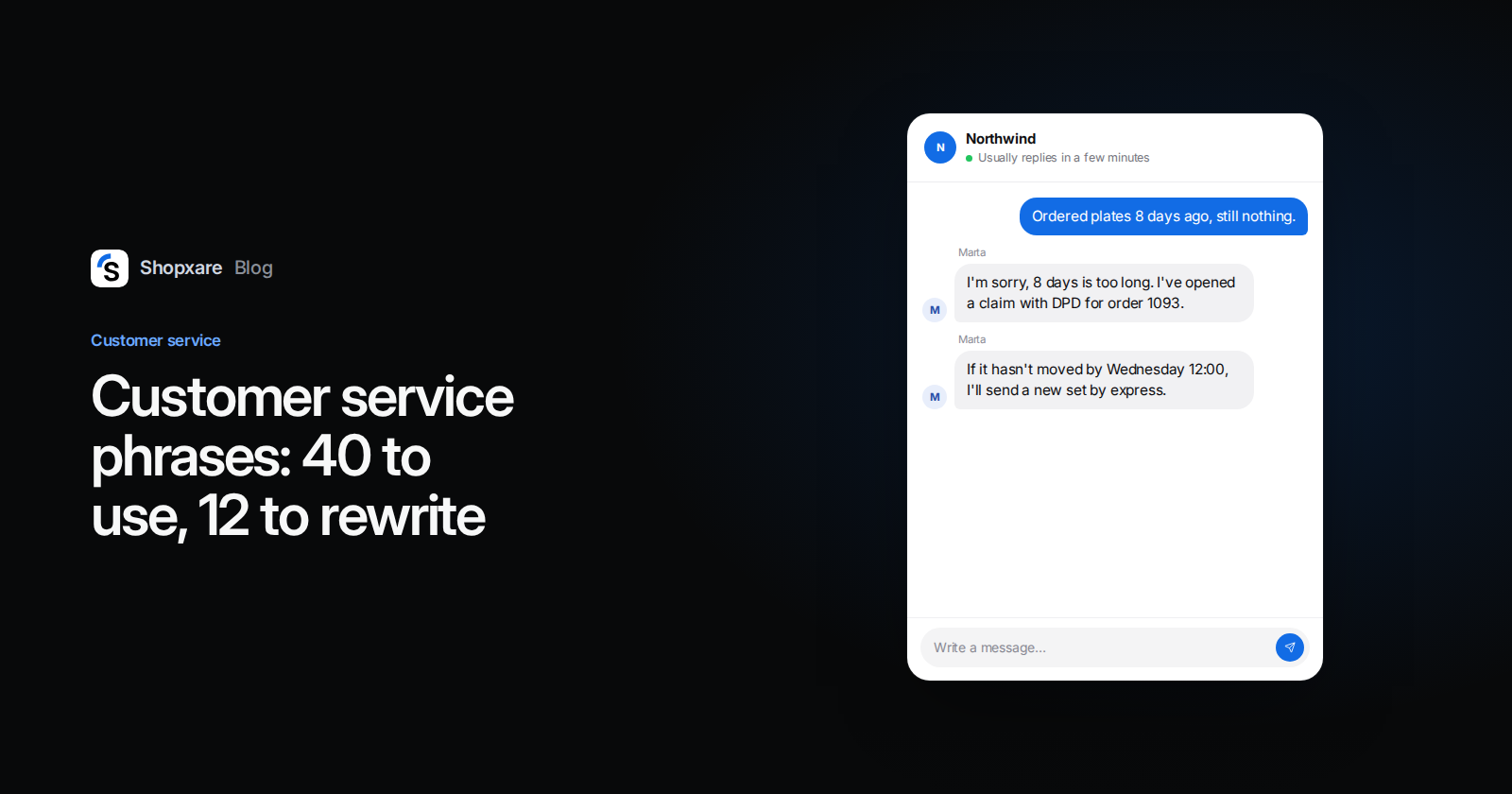
A two-person shop sells ceramic tableware online. On a Monday at 10:14 a customer writes in the chat: "Ordered a set of 6 plates 8 days ago, still nothing. This is ridiculous."
Before: "Hi, we apologise for any inconvenience. Your order has been escalated to our shipping team and we will get back to you as soon as possible. Thank you for your patience."
After: "Hi Mark, I'm sorry, 8 days is too long for the plates. I've checked order 1093: DPD has had it at the Birmingham depot since Thursday without a new scan. I've opened a claim with them just now. If it hasn't moved by Wednesday 12:00, I'll send a new set by express at our cost. I'll message you here either way."
The second reply is longer, but the customer has nothing left to ask. It names the plates and the order, says what I did, gives a time and offers the next step. That is the whole method:
- Name the problem with the specific product, order or date.
- Say what you did or are doing, with "I".
- Give a time for the next update.
- Offer the next step if things don't go to plan.
Make the good phrases your team's default
A list in a shared doc gets read once. To make the phrases stick:
- Turn your top 15 into saved replies with gaps for the order number, product and date, so every insert stays concrete. In Shopxare you type
/in the reply box to insert one, and the customer's name fills in by itself (saved replies). Our 24 canned responses for online stores are a good starting set. - Let an assistant fix the tone, not write the facts. Copilot can rewrite a draft to be friendlier or shorter; nothing is sent until a person sends it. You still add the order number and the date.
- Keep sentences short for customers abroad. With live translation you write in your language and the customer reads theirs. Short, concrete sentences translate better than idioms.
- Read 10 chats a month and mark every "we apologise", "unfortunately", "escalated" and "any inconvenience". Rewrite the saved replies those came from.
For the hardest moments, see our apology message templates.
When a phrase list makes things worse
- The same sentence 30 times a day. Regular customers notice. Keep two or three versions of the replies you send most.
- Empathy where none is needed. "I completely understand your frustration" in answer to a size question sounds fake. Match the feeling the customer actually showed.
- Phrases can't fix a bad rule. If the team says "I can't" about the same policy five times a day, look at the policy.
- Too much detail. Concrete means the one fact that answers the question, not a copy of the tracking log.
FAQ
What should you never say to a customer?
Avoid "calm down", "that's not my job", "you should have read our policy" and "we apologise for any inconvenience". Each one either blames the customer or shows you didn't read their message.
Should customer service agents say "I" or "we"?
Use "I" for what you are doing ("I've sent the replacement") and "we" for company rules ("we ship within two days"). In a study of retailer emails, more use of "I" went with higher satisfaction and more purchases.
How do you say no to a customer politely?
Give the reason in one sentence and follow it with what you can do: "I can't take back worn earrings for hygiene reasons. I can offer a 15% code for another pair."
What are positive phrases in customer service?
Phrases that say what you can do rather than what you can't: "Here's what I can do", "I'll have an answer by 3 pm", "It leaves today if you order before 2 pm".
How do you start a customer service chat?
Greet the customer by name if you have it, say who you are, and show you've read the context: "Hi Sarah, I'm Tom. I can see order 4821. What can I help with?"
If you want these phrases as saved replies your whole team inserts with one keystroke, Shopxare has a free plan.