 Shopxare Team
Customer effort score (CES) measures how easy it was for a customer to get their issue handled. You ask one question right after the conversation closes, usually "[Store] made it easy for me to handle my issue" on a 1–7 agree scale, and report either the average or the share of customers who answered 5, 6 or 7. For a small online store, CES is most useful as a pointer: read the low answers, find the step that made people work, and remove it.
What CES measures, and how it differs from CSAT and NPS
The idea comes from a study of more than 75,000 customers published in Harvard Business Review in July 2010 by Matthew Dixon, Karen Freeman and Nick Toman. Their finding: making service easy did more for loyalty than trying to impress. Gartner, which later took over that research, reported in August 2020 that a high-effort service experience cut the probability of a customer staying to 37%, against 61% after a low-effort one.
| Metric | Question | What it tells you | Best moment to ask |
|---|---|---|---|
| CES | "[Store] made it easy for me to handle my issue." | How much work one support contact cost the customer | Right after a conversation closes |
| CSAT | "How satisfied are you with the help you got?" | How the customer felt about the interaction | Right after a conversation closes |
| NPS | "How likely are you to recommend us?" (0–10) | The relationship with the brand as a whole | Every few months, not after a chat |
CSAT and CES often move together, but not always. A friendly agent who still asks for the order number three times gets a good CSAT and a poor CES. If you already track CSAT, CES is the metric that shows you where the friction is.
The question to ask
Use the standard wording so your numbers mean the same thing over time:
[Store name] made it easy for me to handle my issue. 1 = Strongly disagree … 7 = Strongly agree
This 7-point agree/disagree version is the one survey tools such as SurveyMonkey document as standard. A 5-point "How easy was it to get your issue solved today?" (1 = very hard, 5 = very easy) also works if your survey tool has no 7-point scale. Pick one and keep it; you can't compare a 5-point month with a 7-point month.
Add one optional open question: "What made it harder than it should have been?" That answer is worth more than the score.
Avoid "How much effort did you personally have to put forth?". It was the original 2010 wording, and many customers read a high number as good, so you get noisy data.
How to calculate CES
There are two common ways. Use the second one in reports; it's easier to explain to a team.
- Average: add up all scores and divide by the number of answers.
- Percentage of easy answers: answers of 5, 6 or 7 (on a 7-point scale) ÷ all answers × 100. On a 5-point scale, count 4 and 5.
Worked example. In November a store gets 140 CES answers on a 7-point scale: 22 people answer 1–3, 18 answer 4 and 100 answer 5–7.
- Easy share: 100 ÷ 140 = 71%
- Hard share (1–3): 22 ÷ 140 = 16%
The 22 hard answers are your work list for the week. Read every one, tag the cause, and count the tags.
When to send it in chat and email
- Chat: send it as soon as the conversation is closed, with no delay or a delay of a few minutes. The memory is fresh and the customer is still on the page.
- Email tickets: send it when the ticket is closed, not when you send your first reply.
- Frequency: ask the same customer at most once every 30 days. Regular buyers stop answering if you ask after every message.
- Skip pre-sale chats. "Do you ship to Austria?" answered in 20 seconds tells you little. CES belongs on issues: orders, returns, payments, damaged items.
What is a good customer effort score?
There is no reliable public benchmark for small online stores, and numbers you find in vendor blogs use different scales and questions. Compare yourself with yourself:
- Wait for at least 50 answers before you read a trend. Below that, two angry customers move the score by several points.
- Track the hard share (1–3) weekly. It's the number you can act on.
- Read CES next to first contact resolution. When customers have to write twice, CES drops; fixing one usually fixes the other.
Where effort comes from in an online store
When you tag the low answers, almost all of them land in one of these six causes.
| Cause | What the customer experiences | Fix |
|---|---|---|
| Repeating information | Gives the order number, then gets asked for it again after a transfer | Pass a short note with every handover; show orders next to the chat |
| Channel switching | "Please email us at…" from a chat | Answer in the channel the customer chose, or turn the chat into a ticket yourself |
| Waiting without a time | No reply for hours, no expectation set | Say when you'll answer outside office hours; keep the promise |
| Vague answers | "It should arrive soon" | Give the date, the carrier and the tracking link |
| Coming back | Issue "solved" but the refund never showed up | Close with the next step and a date; follow up yourself |
| Searching for basic answers | Shipping and returns rules hidden in the footer | Put the top ten answers in a help center the chat can show |
Example: the same question, two levels of effort
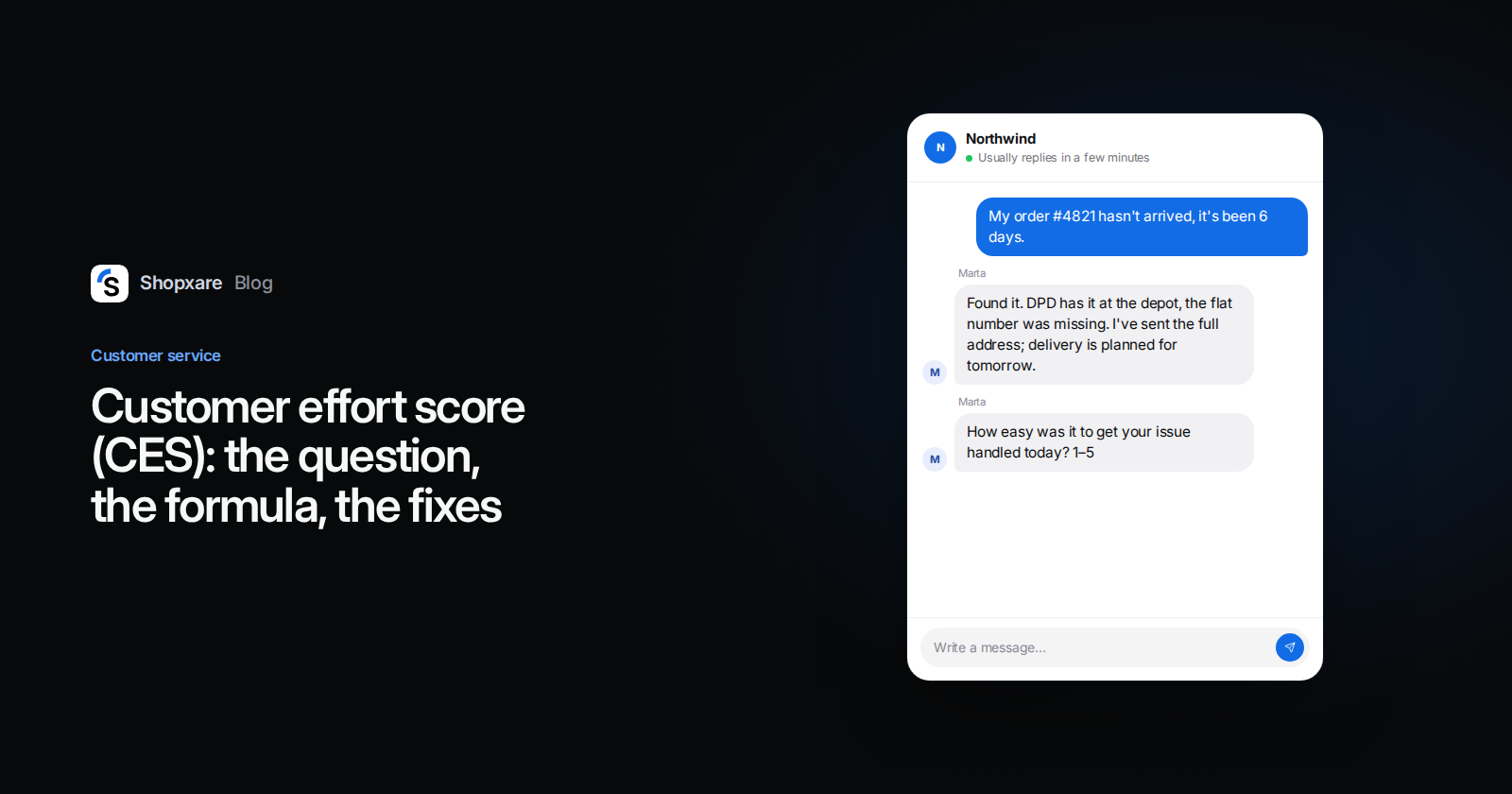
A customer at a small shoe shop writes: "My order #4821 hasn't arrived, it's been 6 days."
High effort: "Sorry about that. Could you send your order number and email? I'll pass this to our shipping team, they'll email you." The customer already gave the number, and now waits for an unknown email.
Low effort: "Thanks, I found #4821. DPD has it at the Leeds depot since Monday because the address was missing a flat number. I've sent them the full address; they plan to deliver tomorrow. Here's the tracking link. I'll check tomorrow at 4 pm and write to you if it hasn't moved."
Same agent, same policy. The second reply removes three steps for the customer: repeating the number, chasing the carrier and checking back.
Setting it up in Shopxare
- Survey: under Surveys, create a Custom survey and choose a rating question. Shopxare offers Stars (1–5) and Faces (1–5) but no 7-point type, so use the 5-point wording above. Set Delivery to After a conversation is closed, and Ask the same person at most every (days) to 30. Each survey shows Average score and Score distribution, and Export CSV gives you the answers for the easy-share calculation.
- Fewer repeats: connect your store under Stores and orders so the customer's orders appear next to the chat, and customers can use Track your order in the Messenger without waiting.
- Fewer vague answers: keep exact wording for shipping, returns and delays in Saved replies.
- Fewer searches: publish your top answers in the Help center.
If you only need the survey and a shared inbox, the free plan covers it, no credit card needed: shopxare.com/en/pricing.
When not to use CES
- Very low volume. Under about 20 support conversations a month, read every conversation instead of scoring them.
- Right after you said no. If the answer was "no refund after 60 days", CES measures the policy, not your service. Tag those separately.
- As a target for individual agents. People start avoiding hard cases. Use CES to find broken processes, not to rank the team.
FAQ
What is a good customer effort score? There's no universal benchmark because companies use different scales and questions. On a 7-point scale, track the share of 5–7 answers and the share of 1–3 answers, and aim to lower the second one month by month.
What is the difference between CES and CSAT? CSAT asks how satisfied the customer is; CES asks how easy it was to get the issue handled. A pleasant but slow process can score well on CSAT and badly on CES.
How do you calculate CES? Either average all scores, or divide the number of easy answers (5–7 on a 7-point scale, 4–5 on a 5-point scale) by all answers and multiply by 100.
Is CES a 1–5 or 1–7 scale? The most widely used version is 1–7 agree/disagree. A 1–5 ease scale is fine if you use it consistently.
When should I send a CES survey? Right after a support conversation or ticket is closed, at most once every 30 days per customer, and not after simple pre-sale questions.