 Shopxare Team
To calculate NPS (Net Promoter Score), ask "How likely are you to recommend us to a friend or colleague?" on a 0–10 scale, then subtract the percentage of detractors (0–6) from the percentage of promoters (9–10). The result runs from −100 to +100. In Survicate's 2025 data the median NPS for retail and ecommerce was 55, and 42 across all industries. With fewer than about 100 answers, your score can move 15 points or more by chance, so read the comments before you react to the number.
Below: the formula with a worked example, a spreadsheet formula you can paste, which benchmarks have real data behind them, how many answers you need, and when an online store should send the survey.
The question and the three groups
NPS comes from Fred Reichheld's 2003 Harvard Business Review article The One Number You Need to Grow. Bain, which holds the trademark, describes the method on its Net Promoter System page:
How likely are you to recommend us to a friend or colleague? (0 = not at all likely, 10 = extremely likely)
Each answer puts the customer in one group:
| Score | Group | What it usually means for a store |
|---|---|---|
| 9–10 | Promoters | Would buy again and tell others |
| 7–8 | Passives | Satisfied, but would switch for a better price or faster delivery |
| 0–6 | Detractors | Unhappy enough to warn others or leave a bad review |
Passives count in the total but not in the score. That is the part people get wrong most often.
The NPS formula
NPS = % promoters − % detractors
Worked example
A shop selling coffee equipment collects 240 answers in a quarter:
| Group | Answers | Share |
|---|---|---|
| Promoters (9–10) | 132 | 55% |
| Passives (7–8) | 60 | 25% |
| Detractors (0–6) | 48 | 20% |
| Total | 240 | 100% |
NPS = 55 − 20 = 35. Write it as a plain number, not a percentage: "NPS 35", not "35%".
Three mistakes to avoid:
- Taking the average score. An average of 8.1 out of 10 is a different metric. Many survey tools show the average by default.
- Dividing by people you asked instead of people who answered. Only answers count. Track the response rate separately.
- Mixing scales. If you once asked on 1–5 stars, those answers cannot go into NPS.
Spreadsheet formula
Put the 0–10 scores in column B (one answer per row) and use this in Google Sheets or Excel:
=(COUNTIF(B:B,">=9")-COUNTIF(B:B,"<=6"))/COUNT(B:B)*100
What is a good NPS?
Only use benchmarks where you can see who was measured:
| Source | Who was measured | Result |
|---|---|---|
| Survicate NPS benchmarks (599 companies, 5.4 million answers, January–October 2025) | Customers of Survicate users, surveys with 100+ answers | Median 42 across industries; 55 for retail and ecommerce (68 in 2024) |
| CustomerGauge retail benchmarks (2026 survey) | Self-reported scores from B2B programs in retail and consumer products | Average 42 |
The two sources measure different companies in different ways, and Survicate's ecommerce median dropped 13 points between two years. Our view: treat anything above 0 as more fans than critics, use 30–60 as the normal range for an online store, and compare yourself mainly with your own last quarter.
How many answers do you need?
This is the part most NPS guides skip. NPS moves more by chance than a simple percentage, because it is a difference of two shares. We calculated the 95% margin of error for a measured NPS of 35:

| Answers in the period | The real NPS is probably within |
|---|---|
| 30 | ±28 points |
| 50 | ±22 points |
| 100 | ±16 points |
| 200 | ±11 points |
| 400 | ±8 points |
| 1,000 | ±5 points |
(Formula: 1.96 × √((p + d − (p − d)²) ÷ n), with p and d as the promoter and detractor shares and n the number of answers.)
What this means in practice:
- Under 100 answers per period, report NPS quarterly, not monthly.
- A change of less than 10 points with a few hundred answers is usually noise.
- Below about 30 answers, skip the score and read every comment.
When to ask in an online store
NPS measures the relationship with your shop, not one conversation. Timing matters more than wording.
- Ask after the customer has the product. 7 to 14 days after delivery works for most stores. Asking at checkout measures the checkout.
- Don't ask right after a support chat. That moment is for CSAT, which rates one conversation. Our CSAT guide covers it.
- Ask the same person at most every 90 days. Repeat buyers otherwise get a survey with every order.
- Always add one follow-up question. "What is the main reason for your score?" The comments are where the work is.
Example: the score that wasn't a support problem
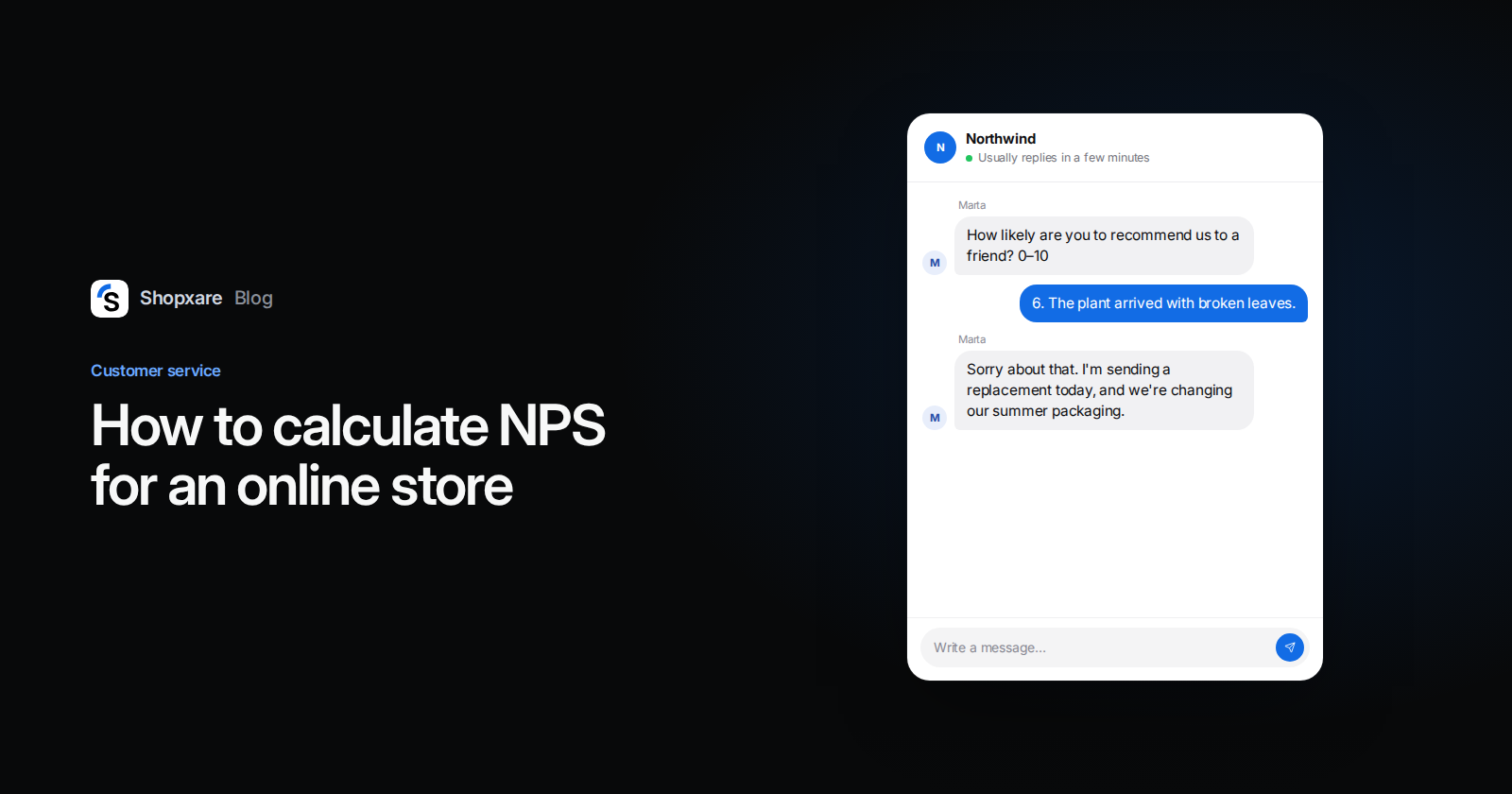
An online plant shop sends its survey link in a delivery follow-up email 10 days after each order. In the third quarter it gets 180 answers: 92 promoters, 47 passives, 41 detractors. NPS = 51.1 − 22.8 = 28, give or take 12 points.
The owner wanted to retrain the support team. The detractor comments said something else: 19 of the 41 mentioned plants arriving damaged during a heatwave, 9 complained about delivery times, and 6 about support replies. The fix was insulated packaging in summer. Support needed a better saved reply for damaged deliveries, not training.
What to do with each group
Sort answers once a week and reply to detractors within two working days. A personal reply often changes the outcome more than the survey itself.
Detractor (0–6):
Hi {first name}, thank you for the honest score. I'm sorry the order didn't go well. Could you tell me what happened? I'd like to fix it for you, and for the next customer.
Passive (7–8):
Hi {first name}, thanks for your score. What is the one thing we could do better so it would be a 10 next time?
Promoter (9–10):
Hi {first name}, thank you, that made our day. If you have a minute, a short review on {review site} helps other customers decide.
For complaints that come out of detractor comments, the steps in how to respond to a customer complaint apply.
Setting up an NPS survey in Shopxare
Shopxare has NPS built in under Surveys (docs):
- Go to Surveys and click Create under NPS. You get the 0–10 question plus a follow-up question.
- Under Delivery, choose Only via a shareable link and add the link to your post-delivery email, receipts or a QR code in the parcel. The other option, After a conversation is closed, sends it after a chat or email conversation, but for a relationship score the delivery email is the better moment.
- Set Ask the same person at most every (days) to 90.
- Click Activate. Nothing is sent before that.
The results page shows sent, answered, response rate, average score and the score distribution. To get NPS, add the share of 9s and 10s and subtract the share of 0–6, or use Export CSV with the spreadsheet formula above. Answers from customers who also chat with you sit next to their conversations, and the reports show your response times and CSAT in the same place. Shopxare is free, without a credit card.
When NPS is the wrong tool
- Low volume. With 20 answers a quarter, the number tells you nothing. Read the comments.
- Rating support agents. Detractors usually complain about delivery, price or product. Use CSAT per conversation instead.
- As a growth predictor on its own. Reichheld argued NPS predicts growth. A replication by MeasuringU in 2018 found it explained part of later growth (R² of 38% over two years). Keiningham and colleagues (2007) found it no better than other satisfaction measures in several industries (MeasuringU summary). It is a useful signal, not a forecast.
For the other numbers worth tracking next to NPS, see customer service KPIs for online stores.
FAQ
What is a good NPS score?
For an online store, 30 to 60 is a normal range. Survicate's 2025 data puts the median at 55 for retail and ecommerce and 42 across all industries. Your own trend matters more than any benchmark.
Can NPS be negative?
Yes. If more customers give 0–6 than 9–10, the score is below zero. The lowest possible NPS is −100 (everyone a detractor), the highest is +100.
How many responses do you need for a reliable NPS?
At 100 answers the margin of error is about ±16 points, at 400 about ±8. Below 100 answers per period, compare quarters rather than months and focus on the comments.
What is the difference between NPS and CSAT?
CSAT rates one interaction, such as a chat, right after it happens. NPS asks about the relationship with your brand, on a 0–10 scale, a while after the purchase.
How often should you send an NPS survey?
Send it once per order, 7–14 days after delivery, and ask the same customer at most every 90 days.