 Shopxare Team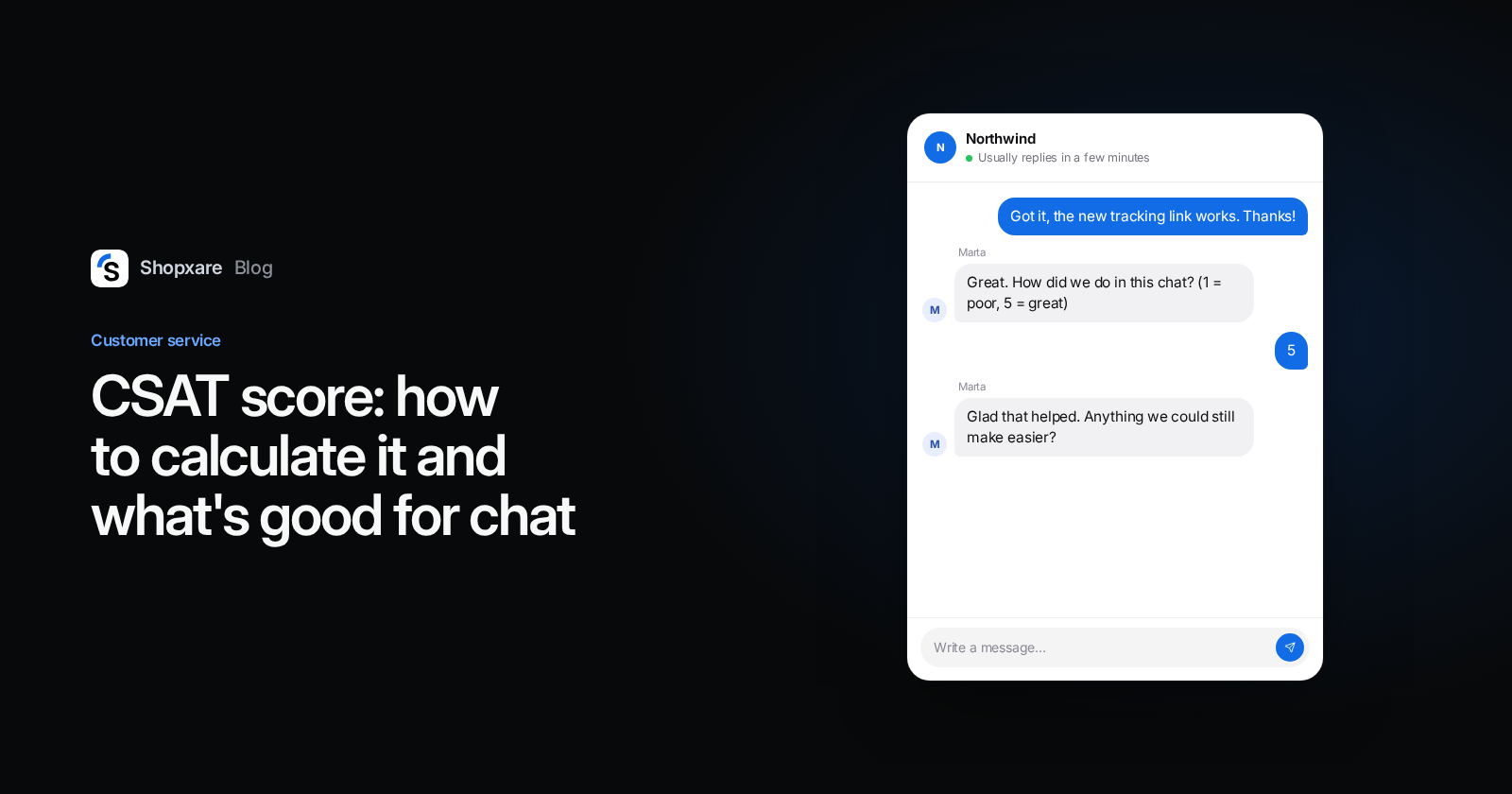
CSAT (customer satisfaction score) is the share of rated conversations that customers marked as satisfied, usually 4 or 5 on a 5-point scale: satisfied ratings ÷ all ratings × 100. In 2025 survey data the median CSAT was 80%, and most teams land between about 65% and 90%. With fewer than about 100 ratings a month, treat any change under 10 points as noise and read the comments instead.
That is the short version. Below is how to set it up for live chat, how to calculate it without fooling yourself, and what to do with the ratings once they come in.
What CSAT measures (and what it doesn't)
CSAT asks one question right after an interaction: "How satisfied were you with this conversation?" The customer answers on a short scale, and you count how many picked one of the top answers. IBM's definition is the common one: add the positive responses (4 or 5 out of 5), divide by all responses and multiply by 100 (IBM, 2024).
It measures how one conversation felt. It does not measure loyalty, and it mixes two things you need to keep apart:
- how your team handled the chat (speed, tone, whether the problem got solved);
- what the customer thinks of your policy, product or courier (the refund rule, the late parcel).
A perfect reply about a 14-day return window can still get a 1 from someone on day 20. That is why the review step further down matters more than the number.
How to calculate CSAT
CSAT (%) = number of satisfied ratings ÷ total number of ratings × 100
Which answers count as "satisfied" depends on the scale:
| Scale | Counted as satisfied |
|---|---|
| 1–5 stars or numbers | 4 and 5 |
| 1–10 | 6–10 in the Survicate benchmark, but 8–10 is a stricter and common choice |
| Thumbs up / thumbs down | thumbs up |
| Three faces (bad / okay / great) | great only |
Pick one rule, write it down and never change it mid-year. Most "our CSAT jumped" stories are a changed scale.
Three mistakes to avoid:
- Dividing by all conversations. Unrated chats are not unhappy chats. Divide by ratings only, and track the response rate separately.
- Averaging the stars. An average of 4.2 stars is a different metric. CSAT is a percentage of satisfied answers.
- Mixing channels. Chat and email ratings behave differently. Report them side by side, not merged.
What is a good CSAT score?
Two sources with real data behind them:
| Source | What was measured | Result |
|---|---|---|
| Survicate CSAT benchmarks (1,259 surveys, 370 companies, responses from 2025) | Share of 4–5 answers on 5-point scales (and equivalents) | Median 80%, middle half 64.8–90.0%. Retail/wholesale median 84.2% |
| LiveChat Customer Service Report (data last updated 2024, over 35,000 companies) | Average satisfaction from chats customers rated | 64.2% overall. Only 6.7% of chats were rated |
The 16-point gap between the two shows the real lesson: benchmarks from different tools use different scales and samples, so they are not comparable with each other or with you. Use them as a sanity check (below 60% means something is wrong; above 90% with few ratings means you may only hear from fans), then compare yourself with your own last quarter.
Our opinion: for a small online store, aim to hold steady around 80% and spend your energy on the bad ratings, not on chasing 95%.
How many ratings do you need?
This is the part most CSAT articles skip. The fewer ratings you have, the wider the range the real value could be in. We calculated 95% intervals (Wilson method) for a measured CSAT of 80%:
| Ratings in the period | The real CSAT is probably between |
|---|---|
| 20 | 58% and 92% |
| 50 | 67% and 89% |
| 100 | 71% and 87% |
| 200 | 74% and 85% |
| 400 | 76% and 84% |
| 1,000 | 77% and 82% |
With 50 ratings a month, a drop from 80% to 72% can be pure chance. Rules that follow from this:
- Under about 30 ratings a month, don't report a percentage at all. Read every comment.
- Compare quarters, not weeks, until you get 100+ ratings per period.
- Don't rank agents by CSAT unless each has at least 50 ratings. Otherwise you are ranking luck.
Example: did CSAT really drop?
A shop selling coffee equipment closed 600 chats in September. 54 were rated, 43 of them 4 or 5 stars: CSAT 79.6%. In October 48 were rated and 36 were positive: 75.0%.
The owner wanted to retrain the team. But the September interval is about 67–88% and October's about 61–85%. They overlap almost completely. The useful move was reading the 12 bad October ratings: 7 were about a courier delay in one region, 2 about a refund rule, 3 about slow replies on a Saturday. Only those last 3 were a support problem, and the fix was a weekend after-hours message, not training.
When and how to ask in live chat
- Ask once, right after the conversation closes. Not in the middle, and not by email two days later.
- One question plus an optional comment box. In Survicate's data the median completion rate was 100% for one-question surveys and 82.5% for three questions (2025).
- Expect few answers. Survicate's median response rate was 7.5%, and LiveChat saw 6.7% of chats rated. That is normal, which is why the sample-size table above matters.
- Don't ask after spam, test chats or chats where the customer never replied.
Wording you can copy:
How did we do in this chat? (1 = poor, 5 = great)
Follow-up after a low rating:
Thanks for telling us. What should we have done differently?
Follow-up after a high rating:
Glad that helped. Anything we could still make easier?
In Shopxare you switch on rating after closing in the Messenger settings (Customize the Messenger), and CSAT appears next to conversation count, median first response time and median time to close in the Conversations report, filterable by channel, team or teammate (Reports).
What to do with a bad rating
Once a week, open every rating of 1–3 and give it one tag:
| Tag | Meaning | Who fixes it |
|---|---|---|
| Speed | waited too long, or no answer after hours | Support lead: staffing, first response time |
| Answer | wrong, vague or incomplete reply | Support: saved replies, help articles |
| Tone | felt rude, robotic or dismissive | Support: coaching |
| Policy | disliked a rule (returns, fees) | Owner or management |
| Product / delivery | the item or courier was the problem | Operations |
Only the first three are about your support team. If most bad ratings are "policy" or "delivery", the chat team is carrying someone else's problem, and the CSAT report is your evidence for that meeting.
For the "answer" tag, the fastest fix is usually a better saved reply. Shopxare's saved replies open with "/" in the composer, so improving one reply improves every chat that uses it. For angry customers who rated low, a short personal follow-up often repairs more than the next survey; our guide to responding to complaints has templates.
CSAT vs NPS vs CES
| CSAT | NPS | CES | |
|---|---|---|---|
| Question | How satisfied were you with this conversation? | How likely are you to recommend us? | How easy was it to get your issue solved? |
| Measures | one interaction | the relationship with the brand | effort in one interaction |
| When to ask | right after a chat | every few months, by email | right after a support case |
| Origin | common practice | Reichheld, HBR 2003 | Dixon, Freeman and Toman, HBR 2010 |
The HBR effort study (more than 75,000 people) argued that reducing customer effort predicts loyalty better than satisfaction scores do. For a small support team, CSAT after chats plus a monthly look at the comments is enough. Add NPS later if you want a brand-level number.
When CSAT is the wrong tool
- Very low volume. Ten ratings a month tell you nothing as a percentage. Read them.
- Bonuses tied to individual CSAT. Agents start avoiding hard chats or asking for 5 stars. Use it for coaching.
- Comparing with another company's number. Different scale, different customers, different response rate.
If you want to try this on your own chats, Shopxare is free with no credit card: the Messenger, ratings after closing and the CSAT report are all included.
FAQ
What is a good CSAT score?
Around 80% is a typical median: Survicate's 2025 data had a median of 80% with the middle half between 64.8% and 90%. Compare yourself mostly with your own earlier periods, because tools measure CSAT differently.
How do you calculate CSAT?
Divide the number of satisfied ratings (4 or 5 on a 5-point scale) by the total number of ratings and multiply by 100. 43 satisfied out of 54 ratings is 79.6%.
What is the difference between CSAT and NPS?
CSAT measures satisfaction with one interaction and is asked right after it. NPS asks how likely someone is to recommend your company on a 0–10 scale and measures the overall relationship.
What is a good response rate for a CSAT survey?
Single digits are normal for chat: Survicate's median response rate was 7.5% (2025) and LiveChat saw 6.7% of chats rated. Keep the survey to one question to get more answers.
Can CSAT be calculated with an average of stars?
You can track an average star rating, but it is a different metric. CSAT is the percentage of satisfied answers, which is easier to explain and less pulled around by a few 1-star ratings.