 Shopxare Team
Short answer: Average handle time (AHT) is the agent time one conversation costs: on the phone, talk time plus hold time plus after-call work, divided by the number of calls. In live chat that formula overstates the work, because one agent answers two or three chats at the same time. For a small support team the most honest number is support hours ÷ conversations handled, and you use it to plan staffing, not as a speed target for people.
Most AHT guides are written for call centres. This one is for teams that answer chat and email for an online store: how to measure handle time when chats overlap, what the published benchmarks really measure, a worked staffing example and a starting limit for concurrent chats.
What average handle time means, and where the phone formula breaks
The classic definition counts everything an agent spends on one interaction: talk time, hold time and after-call work (Genesys). As a formula:
AHT = (talk time + hold time + after-call work) ÷ number of interactions
On the phone that works, because an agent is on one call at a time. In live chat the agent types an answer, switches to another chat while the customer reads, and comes back. The chat stays open the whole time, but the agent only works on it in short bursts.
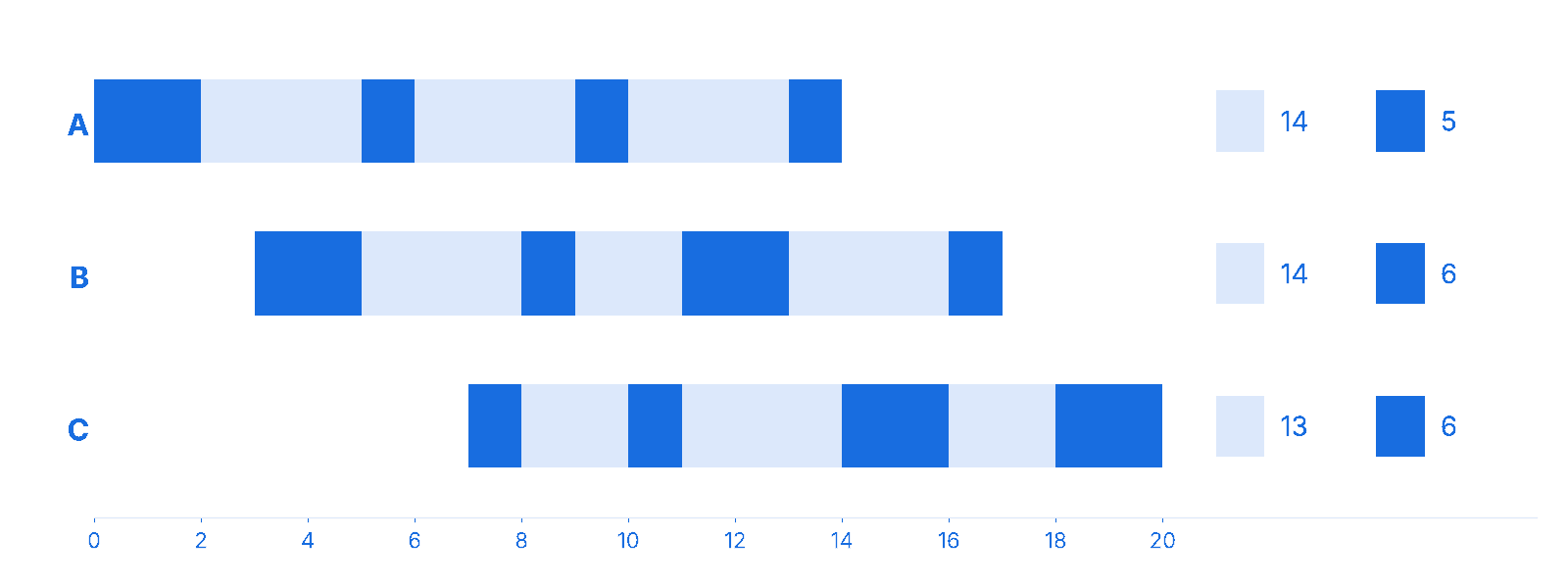
Light bars: how long each chat is open (what the customer experiences). Dark blocks: when the agent is working on that chat. Right: open minutes and worked minutes per chat. Horizontal axis: minutes.
In this example one agent handles chats A, B and C within 20 minutes. Each chat is open 13 to 14 minutes, so the "average chat duration" is 13.7 minutes. The agent actually worked 17 minutes across all three, 5.7 minutes per chat. If you plan staffing with 13.7 minutes, you hire more than twice the people you need.
Three ways to measure AHT in chat and email
| Method | How to calculate | Good for | Trap |
|---|---|---|---|
| Chat duration | Average time from first message to close | Seeing how long customers wait for a full resolution | Counts the customer's thinking time and parallel chats; overstates work |
| Active work time | Time an agent spends typing and reading inside each conversation | Large teams with tooling that tracks it | Few small-team tools measure it; misses research in other tabs |
| Workload method | Hours spent on support ÷ conversations handled | Small teams, staffing, comparing months | Needs honest hours; mixes channels unless you split them |
Our recommendation for a store with one to ten people: use the workload method. It needs no special software, it includes the time spent checking orders in your shop admin, and it answers the question you care about: how many hours does a given number of conversations take?
A worked example
A small fashion store has two people answering chat and email. In one normal week in October:
- Conversations handled: 380 chats and 140 emails, 520 in total.
- Hours spent on support (from their own time log, without breaks and other tasks): 52.
AHT = 52 hours × 60 ÷ 520 = 6.0 minutes per conversation
Now they plan December. Last year December brought 1.6 times the October volume, so they expect about 830 conversations a week.
- Handling time needed: 830 × 6.0 minutes = 4,980 minutes, about 83 hours.
- Add slack: nobody is busy 100% of a shift. We plan with people busy about 80% of their support time, so 83 ÷ 0.8 ≈ 104 hours.
- Compare with capacity: two people with 30 support hours each give 60 hours. They are 44 hours short a week.
That gap is the decision: a seasonal helper, fewer repeat questions reaching a person, or longer reply targets during the peak. Our Black Friday customer service plan walks through the same maths week by week.
If you want AHT per channel, track one week where each person writes down whether a block of time went to chat or to email. Email often takes longer per message, chat often has more messages.
Benchmarks: what the published numbers measure
The largest public dataset we found is Comm100's Live Chat Benchmark Report 2025, based on more than 220 million chat interactions. For 2024 it reports:
| Industry (2024) | Average chat duration |
|---|---|
| All industries | 8 min 50 s |
| B2C eCommerce | 18 min 15 s |
| Travel and hospitality | 25 min 50 s |
| iGaming | 5 min 44 s |
Read these as chat duration, not handle time. They include the time the customer spends reading and replying and the moments the agent works on other chats. An 18-minute ecommerce chat does not mean 18 minutes of agent work. Compare your own chat duration with these numbers, and your workload AHT only with your own past months.
How many chats can one agent handle at once?
There is no single right number. The Comm100 report says most agents can handle two chats at once, experienced agents three to four, and new agents may struggle with more than one or two (Comm100, 2025). In an older Call Centre Helper poll of 256 contact-centre professionals (December 2013), 70% said an agent can handle two to three web chats at the same time (Call Centre Helper).
What we suggest for a store:
- Start new teammates at 2 chats, experienced ones at 3.
- Watch first response time for a week. If customers wait longer for the second and third reply, lower the limit.
- Complaints, damaged orders and refunds need full attention. Hand these to someone with a lower load.
- Raise the limit only when chats are mostly short questions with quick answers.
In Shopxare you set this under Settings → Teams & assignment: choose Balanced assignment (whoever has the fewest open conversations), tick Only teammates who are online and not away, and set Max open per teammate so nobody gets overloaded (Teams and assignment). The limit counts open conversations, so leave room for emails that are waiting on a customer.
Seven ways to lower handle time without making service worse
- Saved replies for the top questions. Write shipping, returns and payment answers once and insert them with
/and the shortcut, with the customer's name filled in (Saved replies). - Ask for the order number early. Half the minutes in a "where is my order" chat go to finding the order. A greeting that asks for it saves a round trip.
- Summaries for long threads. When a conversation changes hands, Copilot can write a summary in the contact panel, so the next person doesn't scroll through 40 messages.
- Fix the slowest question type, not the slowest person. Tag one week of conversations and look at which topics take the longest. Usually it is one policy that is unclear on your site.
- Cap concurrent chats. Too many parallel chats make every reply slower and raise mistakes.
- Write the missing help article. Every question your help center answers well is a conversation that never reaches the inbox.
- Translate in place. Copying text to a translator and back takes minutes. Reading the customer in your language and replying in theirs keeps it in one window (Live translation).
When not to chase a lower AHT
Don't make AHT a personal target. People who are judged on speed close conversations early, and the customer writes again tomorrow, which costs more time in total. Genesys, a vendor that sells contact centre software, calls "lower AHT always means better service" a misconception (Genesys).
Track AHT next to customer satisfaction and the number of customers who write back about the same issue. If AHT drops and satisfaction drops with it, you sped up the wrong thing. For the other numbers worth a weekly look, see our customer service SLA guide.
What Shopxare's reports show
Shopxare's Reports page shows conversations, median first response time, median time to close, customer satisfaction, busiest hours and a per-teammate table. Time to close is the full time until a conversation is closed, including waiting for the customer, so treat it like chat duration, not handle time. For the workload method, take the conversation count from Reports and divide your support hours by it. If your package includes exports, Export CSV gives you one row per conversation for your own spreadsheet.
Shopxare has a free plan, so you can measure a normal week before you change anything.
FAQ
What is a good average handle time for live chat?
There is no universal good number, because tools measure different things. Comm100's 2025 report puts average chat duration at 8 minutes 50 seconds across industries in 2024 and 18 minutes 15 seconds for B2C ecommerce, but that includes the customer's time. Compare your AHT with your own past months.
How do you calculate average handle time?
On the phone: (talk time + hold time + after-call work) ÷ number of calls. For a small chat and email team: hours spent on support ÷ conversations handled in the same period.
Does AHT include wait time?
No. The time a customer waits before an agent picks up the conversation is a separate metric (wait time or first response time). AHT starts when the agent starts working.
What is the difference between AHT and first response time?
First response time is how long the customer waits for the first reply. AHT is how much agent time the whole conversation takes. You can be fast on the first and slow on the second, and the other way round.
How many chats can one agent handle at once?
Most teams work with two to three. Comm100 (2025) says most agents can handle two at once and experienced agents three to four; start new teammates at two and adjust with your first response times.