 Shopxare Team
In short: You reduce returns by finding out why each one happens and fixing that cause before the next order, not by making returns harder. Give every return one reason code for four weeks, fix the top two causes (in fashion that is almost always size or fit, then "looks different from the photos"), and answer pre-sale questions in chat while the customer is still choosing. Keep the legal return right easy to use, because a painful return process costs you the next order.
Below: how to measure your return rate, a reason list you can copy, a table that matches each reason to its fix, saved replies for size questions and exchanges, and what not to do.
How big the problem is, and why "harder returns" is the wrong fix
US retailers expect 15.8% of annual sales to come back in 2025, and 19.3% of online sales, which adds up to $849.9 billion (NRF and Happy Returns, 2025). Category matters more than anything else. In the EHI survey of online retailers in Germany, Austria and Switzerland, two thirds of all shops have an item return rate of 10% or less, while 67.5% of fashion shops are above 20% (EHI Retail Institute, 2026).
The same NRF survey shows why you can't simply clamp down: 82% of shoppers call free returns a major consideration when they buy, and about 71% are less likely to shop with a retailer again after a poor returns experience. So the target is fewer avoidable returns, not fewer returns at any price.
Step 1: Measure your return rate the same way every month
Use one formula and stick to it:
Return rate = items returned ÷ items sold × 100
Count returns against the month the items were sold, not the month they came back. Returns arrive weeks after the sale, so October's rate is only complete in late November. Example: you sold 1,200 items in October and 132 of them came back by 30 November. Your October return rate is 11%.
Then split it by category and by product. In most small stores a handful of products cause a large share of returns, and those are where you start.
Step 2: Give every return one reason code
You can't fix "returns". You can fix "the linen shirt runs small". Add a required reason to your return form and tag return conversations in your inbox with the same list:
| Code | What the customer says | Where the cause usually sits |
|---|---|---|
| Too small / too big | "Doesn't fit" | Size chart, fit notes |
| Not as pictured | "Colour is different", "feels cheap" | Photos, material, dimensions |
| Damaged | "Arrived broken" | Packaging, carrier |
| Wrong item | "Not what I ordered" | Picking and packing |
| Doesn't work | "Can't set it up", "stopped working" | Product, instructions |
| Too late | "Came after the date I needed" | Delivery promise |
| Changed mind | "Don't need it anymore", "ordered two sizes" | Buying decision |
Two warnings. Customers often pick the first option or "changed my mind" to get through the form, so add a free-text line and read 20 answers each week. And chats are better evidence than forms: a customer who writes "the 38 is huge, the size chart said chest 96 cm" tells you exactly what to fix. In Shopxare, Topics labels conversations by subject automatically, so you can see how many "size" and "damaged" conversations you had this month without tagging by hand.
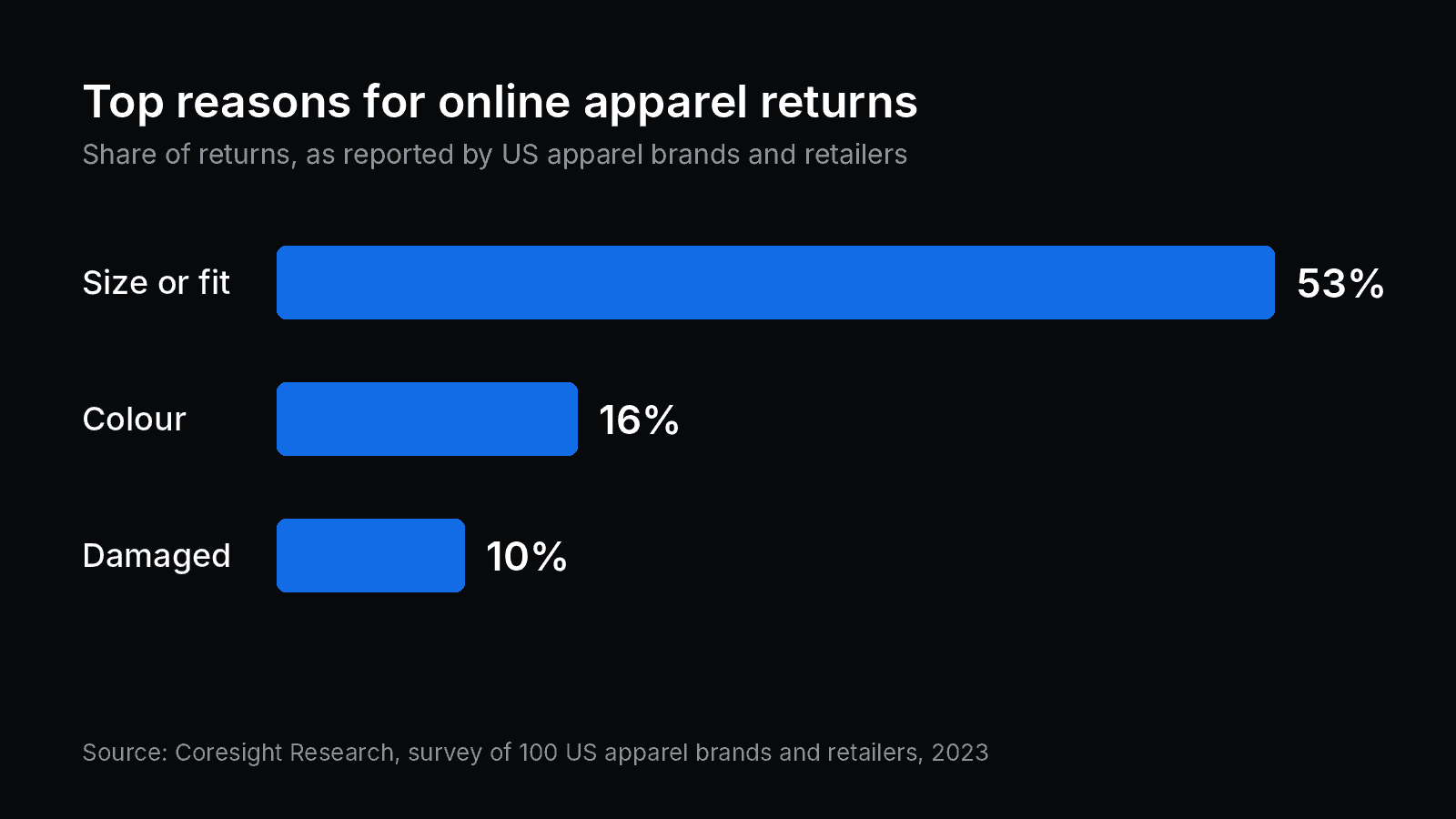
In apparel, retailers say size or fit causes 53% of returns, colour 16% and damage 10% (Coresight Research, 2023, a survey of 100 US apparel brands and retailers). Your mix will be different, and electronics or home goods look nothing like this. That is why you collect your own codes.
Step 3: Fix each cause where it starts
| Reason | Fix | Who owns it |
|---|---|---|
| Too small / too big | A one-line fit note on the product page ("runs small, take one size up if you are between sizes"), garment measurements in cm, not only S/M/L | Product content |
| Not as pictured | Photos in daylight, the material and weight, dimensions next to a familiar object, the words customers used in returns | Product content |
| Damaged | Better packaging for the 3 most damaged products, a photo of each parcel at packing | Warehouse |
| Wrong item | A barcode scan or second check before the box is closed | Warehouse |
| Doesn't work | A setup guide sent on delivery day, one troubleshooting step before the return label | Support |
| Too late | Honest delivery dates at checkout, a message as soon as an order is delayed | Support, operations |
| Changed mind | Leave it alone, but answer size questions fast so people stop ordering two sizes | Support |
Reviews help with fit too. A study of apparel reviews at a large US online retailer of outdoor goods found that when the share of reviews containing both a fit verdict ("true to size") and the reviewer's measurements rose by 10%, the later return rate fell by about 1.6% (Wang, Ramachandran and Sheng, ICIS 2016). Either piece of information alone had no significant effect. So ask reviewers for both: "How does it fit? What is your height and usual size?"
Step 4: Answer pre-sale questions before checkout
A question on a product page is a return you can still prevent. Someone who asks "is the 42 big or small?" is about to guess, and a wrong guess comes back in two weeks.
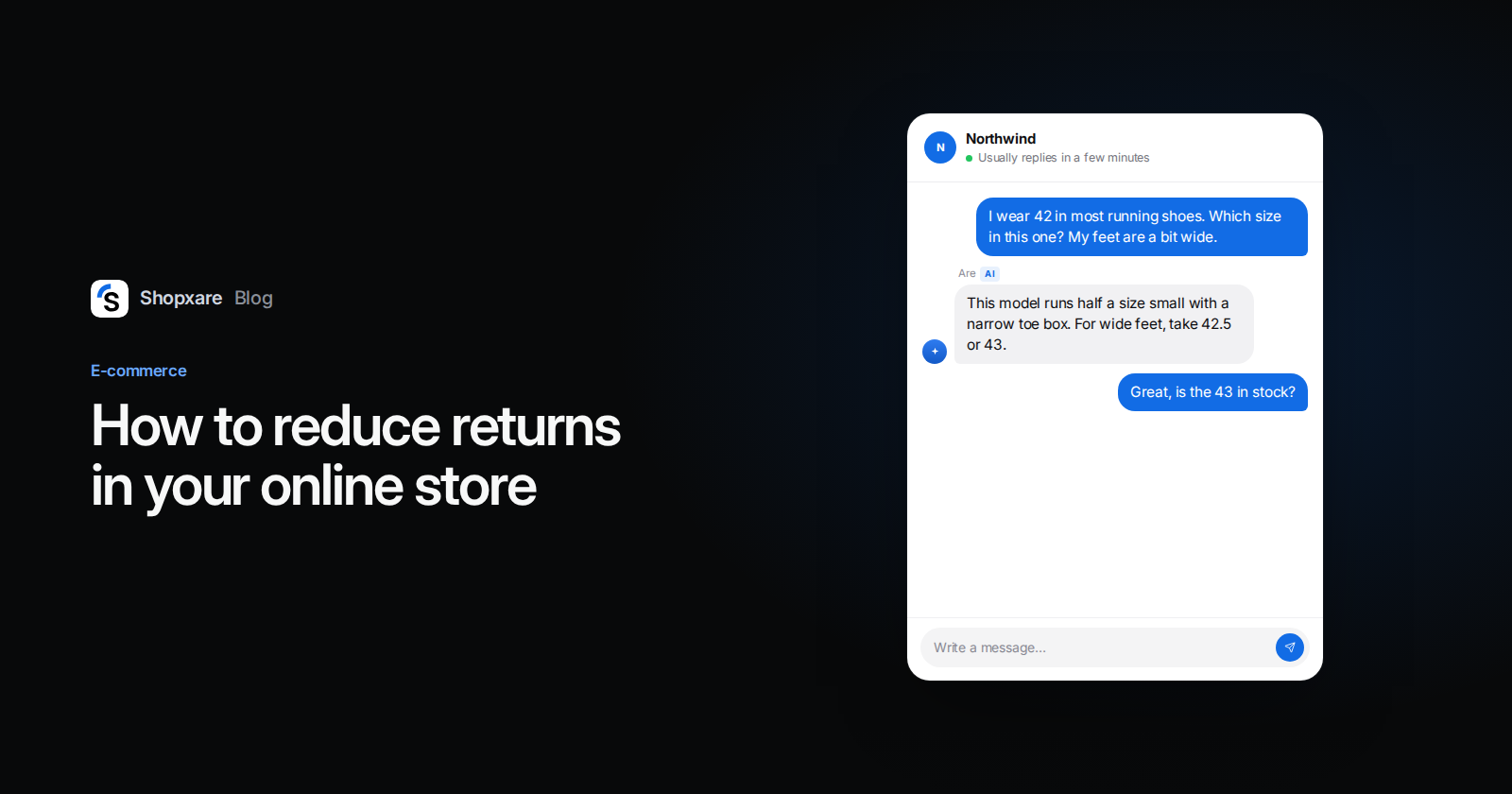
Example. A small trail-running shop gets this in the chat on a shoe page at 21:40:
"I wear 42 in most running shoes. Which size should I take in this one? My feet are a bit wide."
A reply that prevents a return:
"This model runs about half a size small and has a narrow toe box. For a 42 with wide feet, take the 42.5 or 43. If you're between two sizes, the bigger one is the safer choice here. Want me to check if the 43 is in stock?"
Turn your best answers into saved replies. Three to start with:
SIZE ADVICE
Hi {first name}, [product] runs [small / true to size / large].
If you usually wear [size] in [similar brand or product], take [size].
Between two sizes? Go for the [bigger / smaller] one, because [reason].
The full measurements are here: [link to size guide].

COLOUR AND MATERIAL CHECK
Good question. In daylight the colour is closer to [honest description] than in the photo.
The fabric is [material, weight], it feels [soft / firm / structured].
If colour matters a lot for you, I can send a photo of it next to a white sheet.

COMPATIBILITY CHECK
To be sure it fits your [device / model], can you tell me the exact model name?
You'll usually find it [where to look].
If it's not compatible, I'll tell you before you order, so you don't have to send it back.
Shopxare helps in two places here. Are AI answers size and product questions around the clock from your own size guides, product pages and short answers (Teach Are AI), and hands the chat to your team when it isn't sure. With your store connected, it can also recommend products and your team sees the customer's orders next to the chat (Stores and orders). One rule for people and AI alike: if you don't know the fit, say so and find out. A confident wrong answer creates exactly the return you were trying to avoid.
Step 5: Offer an exchange or a fix, when the customer wants it
When a return request comes in, the reason decides the reply:
- Size: offer the other size first, with the refund as an equal option.
- Doesn't work: suggest one troubleshooting step, then the return if it still fails.
- Damaged or wrong item: apologise and replace or refund at once. Don't ask for anything you don't need.
Never make the refund depend on trying the alternatives. NRF found that 76% of shoppers are more likely to pick a return option with an instant refund or exchange, so make both fast.
EXCHANGE OFFER
Sorry the [product] didn't fit. Two options, whichever suits you:
1. Exchange for size [size]: we send it today, and you return the first pair with the label in the box.
2. Refund: send it back with the same label, and we refund within [X] days of it arriving.
Just reply 1 or 2.
For the full set of return and refund replies, see how to respond to a return or refund request. Keep these in saved replies so everyone answers the same way.
What not to do
- Don't hide or slow down the legal right. In the EU, customers have 14 days to withdraw from an online purchase without giving a reason (Directive 2011/83/EU, Art. 9), and since 19 June 2026 online shops must offer a clearly labelled withdrawal function (Directive (EU) 2023/2673). A buried return page doesn't reduce returns. It produces complaints.
- Don't expect return fees to fix the cause. Charging for returns can lower your cost per return, but it does nothing about the wrong size chart. One study found that product reviews lowered return rates, a money-back guarantee raised them, and free return labels had no measurable effect (Walsh and Möhring, Electronic Markets, 2017).
- Don't judge your support team on return rate alone. Agents will start pushing exchanges on people who want their money back. Track the reasons, not just the rate.
- Don't chase "changed my mind" returns. They are part of selling online. Spend your time on fit, photos and damage, where a fix lasts.
A 30-day plan
- Week 1: set up the reason codes on your return form and in your inbox, and calculate last month's return rate.
- Weeks 2–3: collect reasons and read the free-text answers and return chats every Friday.
- Week 4: fix the top two causes on the worst three products, and write the size, colour and exchange saved replies.
- Next month: compare the return rate for those products, and also delivery-day questions about them.
If you want the chat, the AI agent and order details in one place, Shopxare is free and needs no credit card: start here.
FAQ
What is a good return rate for an online store?
It depends on the category. In the 2026 EHI survey, two thirds of online retailers in the German-speaking countries had an item return rate of 10% or less, while most fashion shops were above 20%. In the US, retailers expect 19.3% of online sales to be returned in 2025. Compare yourself with your own last month first.
How do you calculate the return rate?
Divide the items returned by the items sold in the same period and multiply by 100. Count returns against the month of sale and wait a few weeks before you call a month complete.
What is the most common reason for online returns?
In fashion it is size or fit: US apparel retailers put it at 53% of returns in a 2023 Coresight Research survey. Other categories have a different mix, so collect your own reason codes.
Do free returns increase the return rate?
Not necessarily. A 2017 study in Electronic Markets found no measurable effect from free return labels, while a money-back guarantee increased returns. Product reviews lowered them.
Can customer service really reduce returns?
Yes, for the returns that start with a question: size, compatibility, colour and setup problems. Answering those before checkout or before the return label is where support has the most influence.