 Shopxare Team
To get more reviews, ask every customer, in the same neutral words, a few days after the order arrives, and give them one direct link to the review form. Send one reminder at most, offer nothing in return, and never filter out customers you expect to be unhappy. Google, Trustpilot, the US FTC and EU and UK law all punish the shortcuts (rewards, "only happy customers", fake or suppressed reviews), so a plain request is both the safest and, in practice, the one that works.
Does asking actually work?
Yes, and most customers expect it. BrightLocal's Local Consumer Review Survey 2026 (1,002 US adults, published February 2026) found:
| Finding | Share of consumers |
|---|---|
| Were asked to leave a review in the last 12 months | 78% |
| Wrote a review after being asked | 65% |
| Only care about reviews written in the last three months | 74% |
| Won't use a business with fewer than 20 reviews | 47% |
The last two rows matter most for a small store. One push for reviews in spring doesn't help you in November. You need a steady flow, which means a request that goes out after every order without anyone remembering to send it.
The rules: what gets reviews removed or fined
Most "ask for reviews" guides still recommend a discount for a review, or sending the request only to customers who rated you well first. Both are now off-limits on the big platforms, and in several countries they are illegal.
| Who | What it says (checked November 2026) |
|---|---|
| Offering incentives "like free or discounted goods or services" for reviews is "strictly prohibited". Since 2022 its guidelines also ban "discouraging or prohibiting negative reviews, or selectively soliciting positive reviews". | |
| Trustpilot | Invitations "must be fair, neutral, and unbiased with no incentives offered". |
| US (FTC) | The Rule on Consumer Reviews and Testimonials, in force since 21 October 2024, bans fake reviews, rewards tied to a positive (or negative) review, and review suppression. |
| EU | Since 28 May 2022, items 23b and 23c of the Unfair Commercial Practices Directive blacklist fake reviews and claiming reviews come from real buyers without reasonable checks (Directive 2019/2161). |
| UK | Since 6 April 2025 the DMCC Act bans fake reviews and reviews that hide an incentive. See the CMA's fake reviews guidance (CMA208). |
Two practical consequences:
- No review gating. Don't send a "How did we do?" survey and then pass only the 4- and 5-star customers to Google. Send everyone the same request.
- No rewards for the review itself. The FTC rule only bans rewards tied to a sentiment, but Google and Trustpilot ban any reward. Since most stores collect on at least one of them, the simple rule is: no rewards.
One more for EU stores: a review request in an order email isn't automatically a "service" message. In Germany the Federal Court of Justice ruled in 2018 that a satisfaction request in an invoice email, sent without consent, counted as advertising (BGH, VI ZR 225/17). Check your local e-marketing rules before automating, and keep product ads and discount codes out of the request.
When to ask
Ask when the customer has used the product, not when they paid for it. A request that lands before the parcel invites a one-star "haven't received it yet".
| What you sell | Send the request |
|---|---|
| Consumables (coffee, cosmetics, supplements) | 5–7 days after delivery |
| Clothing and shoes | 7–10 days after delivery, after the return window question has settled |
| Electronics, furniture, anything with setup | 14 days after delivery |
| Gifts in December | In January, not in the week before Christmas |
| Support conversation (store review, not product) | Right after the chat or ticket is closed |
Then one reminder 5–7 days later, and stop. Two messages is a request; four is pressure.
Set it up in five steps
- Pick one destination per request. Google for local trust, Trustpilot or your product pages for the store. Two links in one email splits attention and lowers both.
- Get the direct link. On Google, create the review link or QR code from your Business Profile (Google's instructions). Test it on a phone while logged out.
- Write one request and one reminder from the templates below, in your own voice.
- Automate the timing in your shop platform or email tool, based on the delivery date where possible.
- Answer every review, good and bad, within a few days. BrightLocal's 2026 survey found 89% of consumers expect the business to respond.
9 templates to copy
Replace the brackets. Keep the customer's name and the product name, because those two details are what make a request read like it came from a person.
1. Email after delivery (products)
Subject: How is your [product] working out?
Hi [first name],
Your [product] arrived on [date]. If you've had a chance to use it, would you write a short review? Two sentences about what you like or don't like help the next customer decide.
[Write a review]
Thanks, [Name] at [Store]
2. Reminder (one only)
Subject: One quick question about your order
Hi [first name], a last note from us about your [product]. If you have a minute, an honest review helps other shoppers and tells us what to fix: [link]. We won't ask again for this order.
3. SMS or messaging app (opted-in customers)
[Store]: Hi [first name], how is the [product]? An honest review takes about a minute: [short link]. Reply STOP to opt out.
4. Store review after a support chat
Thanks for sorting this out with us today. If you'd like to tell other shoppers how the support went, you can leave a review here: [link]. Good or bad, we read all of them.
5. After a resolved complaint
Your replacement is on its way, tracking: [link]. Whenever you're ready, we'd value an honest review of how we handled this: [link]. If anything still isn't right, reply here first and I'll deal with it.
Note the wording: the customer is invited to review either way. "Contact us before leaving a bad review" is the kind of discouragement Google's rules prohibit.
6. Packaging insert card
Thanks for ordering from [Store]. Tell us how we did: scan the code or visit [short URL]. Honest reviews, good and bad, help us and the next customer.
7. Repeat customer or wholesale buyer
Hi [first name], you've ordered from us [number] times now, so you know our [product range] better than most. Would you write a short review on [platform]? It makes a real difference to a shop our size: [link].
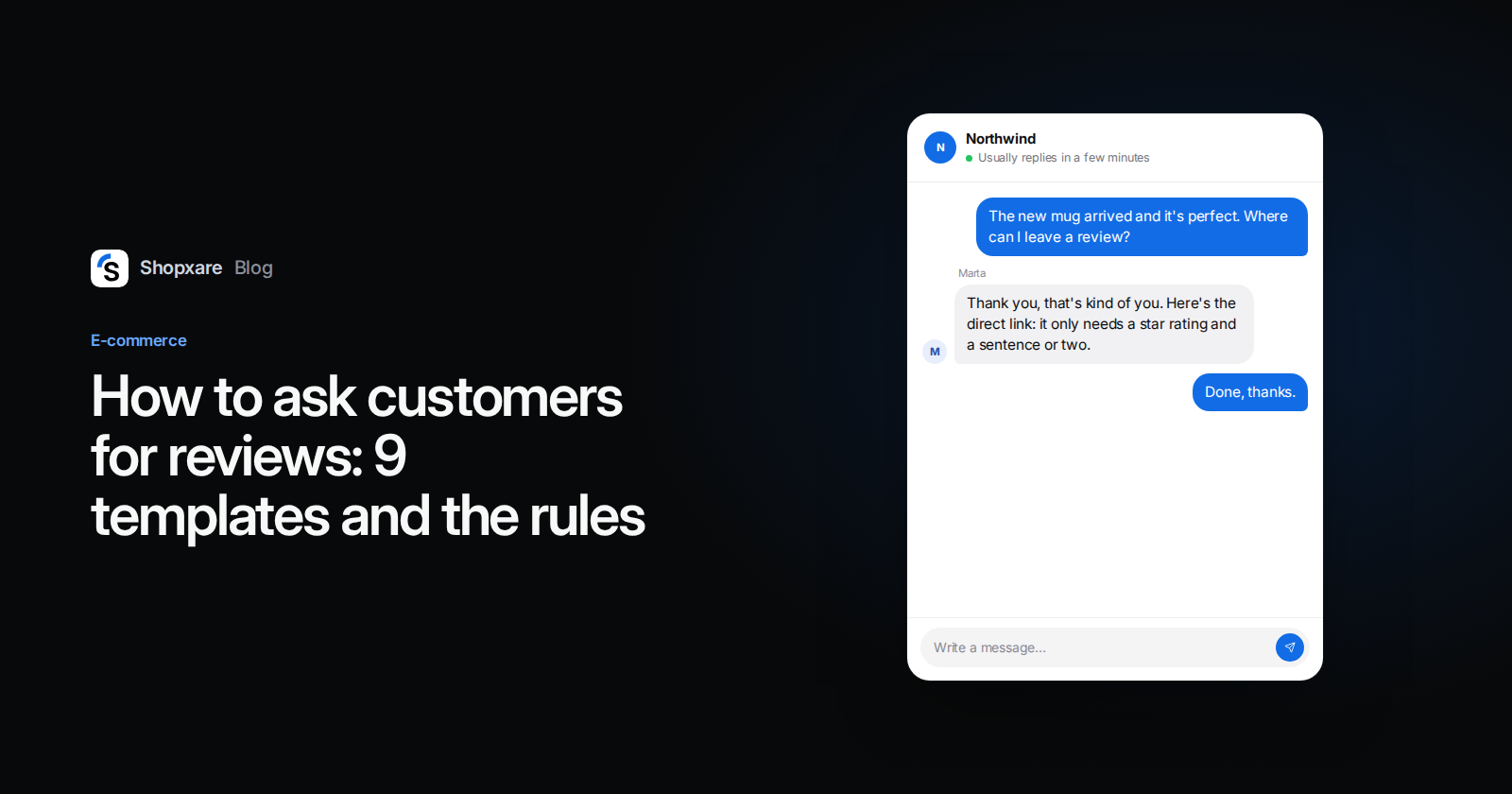
8. Customer who asks "where do I leave a review?" in chat
Thank you, that's kind of you. Here's the direct link: [link]. It only needs a star rating and a sentence or two.
9. Replying to a review after it's posted
Thanks, [first name]. Glad the [product] fits the way you hoped. [One specific detail from their review, or what you changed because of it.] [Your name], [Store]
BrightLocal found that templated or generic replies make 50% of consumers less likely to choose a business, so treat template 9 as a structure, not a copy-paste.
Example: a 3-person candle shop
A candle shop ships about 300 orders a month on Shopify and has 14 Google reviews. They set up template 1 to go out 6 days after delivery, with template 2 five days later, both linking to the Google review form. In the support inbox, everyone closes a resolved chat with template 4. They answer each new review the same week. No discount, no survey filter. A customer whose candle cracked in transit gets a replacement and the same request as everyone else, using template 5.
What they skip: a "rate us 1–5" step that only shows the Google link to 5s. It looks clever and it's exactly what Google calls selective solicitation.
Mistakes that cost reviews
- Asking before delivery. Use the delivery date, not the order date.
- Asking for five stars. "If you loved it, give us 5 stars" is pressure and, on some platforms, a rule break. Ask for an honest review.
- Long forms. A link to your homepage and "find us on Google" loses most people. Link straight to the form.
- Staff review quotas. Targets push people to ask only the customers they expect to be happy.
- Copy-paste replies. A thank-you that could fit any review reads like nobody read it.
When not to ask
- The customer has an open complaint or a refund in progress. Finish the case first.
- The order was cancelled or never arrived.
- The customer has said they don't want marketing emails and your request goes by email. Use the packaging card instead.
- You are in a dispute or chargeback with them.
Doing this in Shopxare
Shopxare doesn't post reviews to Google or Trustpilot for you; it helps with the conversations around them.
- Templates 4, 5 and 8 work well as saved replies: type
/, pick the reply, and the customer's name is filled in. A saved reply can also close the conversation in the same step. - If you also measure satisfaction, use Surveys for CSAT or NPS. Keep it separate from the review request: the survey result must not decide who gets the review link. Our guide to customer satisfaction survey questions covers the wording.
- Complaints first: our guide on how to respond to a customer complaint helps you resolve the case before template 5.
The free plan includes two seats, saved replies and one survey, no credit card needed: shopxare.com/en/pricing.
FAQ
What is the best way to ask a customer for a review? A short, personal email a few days after delivery with the customer's name, the product name and one direct link to the review form, followed by a single reminder.
Can I offer a discount for a review? Not on Google or Trustpilot, which ban incentives of any kind. The US FTC rule bans rewards tied to a positive or negative review, and the UK bans reviews that hide an incentive.
Is it legal to ask only happy customers for reviews? Google's guidelines prohibit selectively soliciting positive reviews and Trustpilot requires unbiased invitations. Send every customer the same request.
How soon after a purchase should I ask for a review? After the customer has used the product: about a week after delivery for most items, two weeks for products that need setup, and right after closing for a support conversation.
How many times can I ask for a review? One request and one reminder per order is a good limit. More than that reads as pressure.